 Product Description
  Price Search
  Combine LLMs & Vision
  Fine-tune & Deploy
 Recognize Every Palworld TCG Card in English and Japanese
Ximilar’s card AI now handles Palworld card recognition in English and Japanese, from a single scan. Test it in the App, via API or the demo.

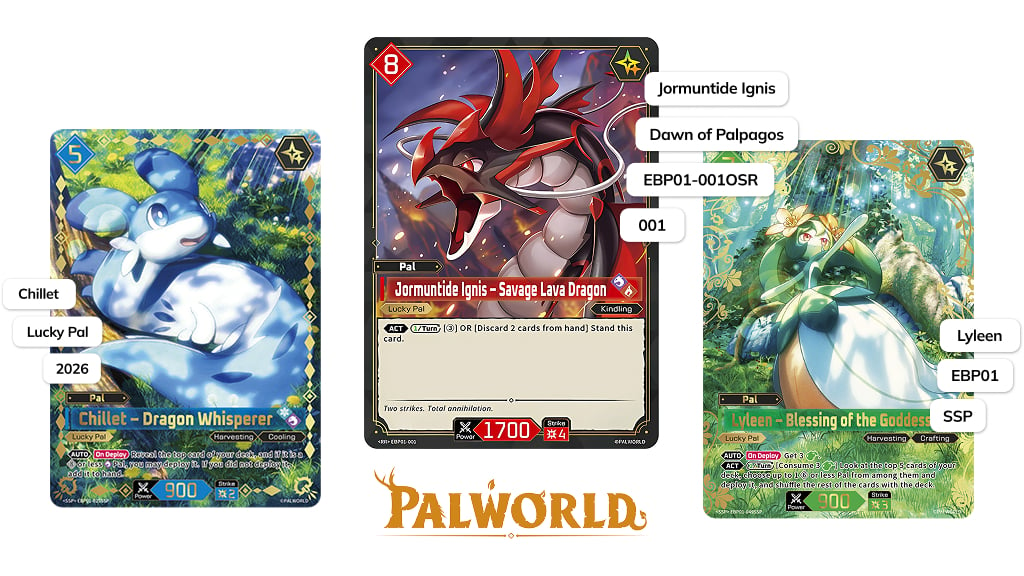
Building the best Trading Card Game (TCG) identification software in the world is one of Ximilar’s core missions. We keep adding new games constantly, and this time it is one that reached shops only a few weeks ago. Palworld Official Card Game launched worldwide on 30 July 2026, and all its cards are already identifiable in our Collectibles Recognition service.
Palworld Official Card Game (OCG) recognition runs on the same endpoint as every other game we support. So any tool already built on Ximilar can add it with no extra work. This is a brand-new TCG, but the intellectual property behind it is anything but small. A game with tens of millions of players tends to bring its audience along when it moves to cardboard.
Card Scanning API for TCG
Ximilar’s TCG identifier (/collectibles/v2/tcg_id endpoint) turns a photo of your physical cards into precise identification. It detects each card in the image, crops it, and works out which game and language it belongs to. Then it matches the card against our database of millions of card printings.
The service identifies cards from over 20 TCGs in real time with 99.9% accuracy, even on low-quality, blurry and low-resolution images. Slabs, sleeves and angled phone shots all work. A single request can scan a whole page of cards at once.
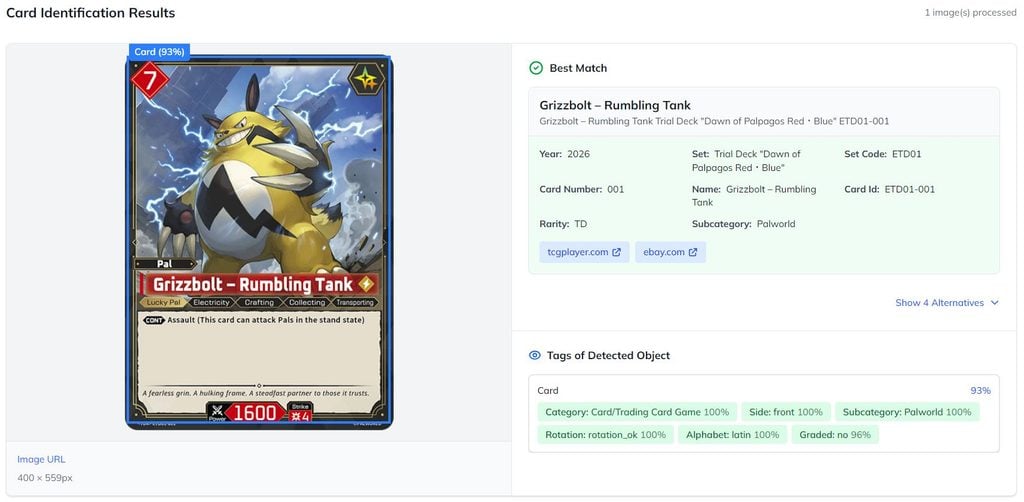
For Palworld, you pass no lang parameter and no game parameter, because the system detects both on its own. The same call reaches Pokémon, Yu-Gi-Oh!, Magic, One Piece, Lorcana, Riftbound, Gundam, hololive, Duel Masters and the rest of our line-up. See the full taxonomy for the complete list.
That breadth is the practical selling point. One integration keeps a collector app, marketplace or scanning tool current across dozens of games, alphabets and grading standards. The API is useful not only for collection tracking, but for value tracking as well. Identified cards also carry marketplace links for pricing where they exist.
It is among the most mature and comprehensive systems for collectibles identification available. That is why many developers build on Ximilar’s REST API instead of training a separate model for every new game from scratch.
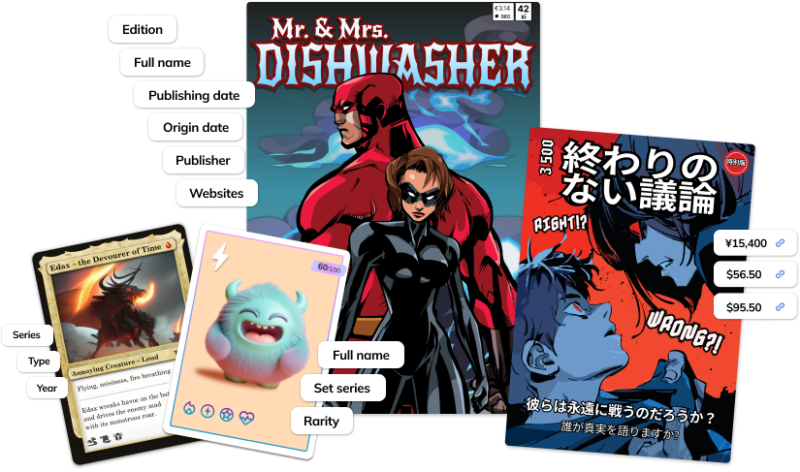
ONE API TO RULE THEM ALL
AI That Understands Collectibles
Recognize, analyze & grade collectibles, find them in databases and marketplaces. Our API was built by collectors for collectors.
From “Pokémon with Guns” to a Bushiroad TCG: Where Palworld Came From
Palworld comes from Pocketpair, a Tokyo studio founded in 2015 by Takuro Mizobe and previously known for Craftopia (2020).
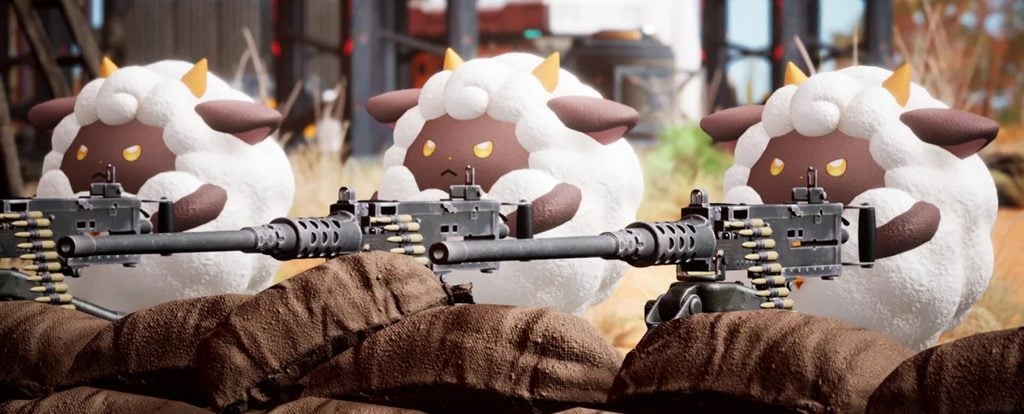
On 5 June 2021 the studio revealed an open world full of creatures called Pals. You catch them, ride them, put them to work at your base – and arm them with guns. The internet immediately nicknamed it “Pokémon with guns.” Mizobe, then leading a five-person team, told Axios that the closest comparison was Ark: Survival Evolved, not Pokémon. The nickname stuck anyway, and the trailer went viral.
A Record-Breaking Video Game
Palworld entered Steam Early Access on 19 January 2024. It sold one million copies in its first eight hours. Five million followed within three days, and Steam sales passed twelve million in under two weeks.
On Xbox, the game became the biggest third-party launch in Game Pass history. At its peak it drew 2.1 million concurrent players on Steam. That was the second-highest figure ever recorded on the platform at the time.
A PlayStation 5 version followed in September 2024, and version 1.0 arrived on 10 July. Analysts now estimate around 30 million copies sold and more than 40 million players.
How Palworld Became a Bushiroad Card Game
That franchise now includes a card game. Bushiroad – the publisher behind Cardfight!! Vanguard, Weiss Schwarz and hololive Official Card Game – announced it on January 12th. Bushiroad handles product planning and the worldwide release, Yuhodo designed the game, and the original IP is Pocketpair’s Palworld.
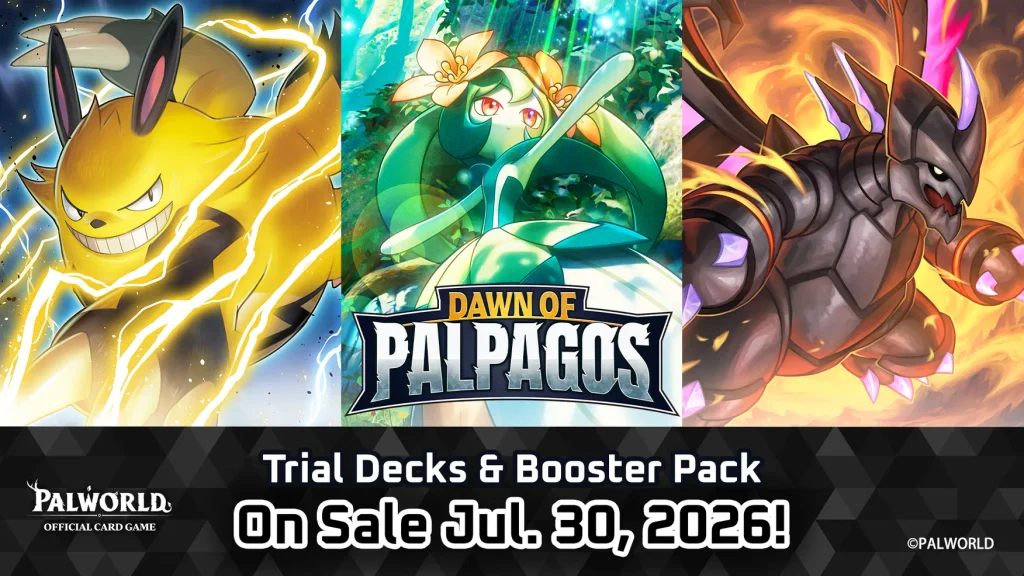
Palworld OCG launched simultaneously in English, Japanese and Simplified Chinese on 30 July. The launch included one booster pack and two trial decks (ready-to-play starters). Each one is a complete 50-card main deck plus 10 Souls, a playmat and a booster pack. All cards use original illustrations.
Regional qualifiers start this autumn, and a World Championship is scheduled for Card Game Festival 2027.
How to Play Palworld: Decks, Card Types and Combat
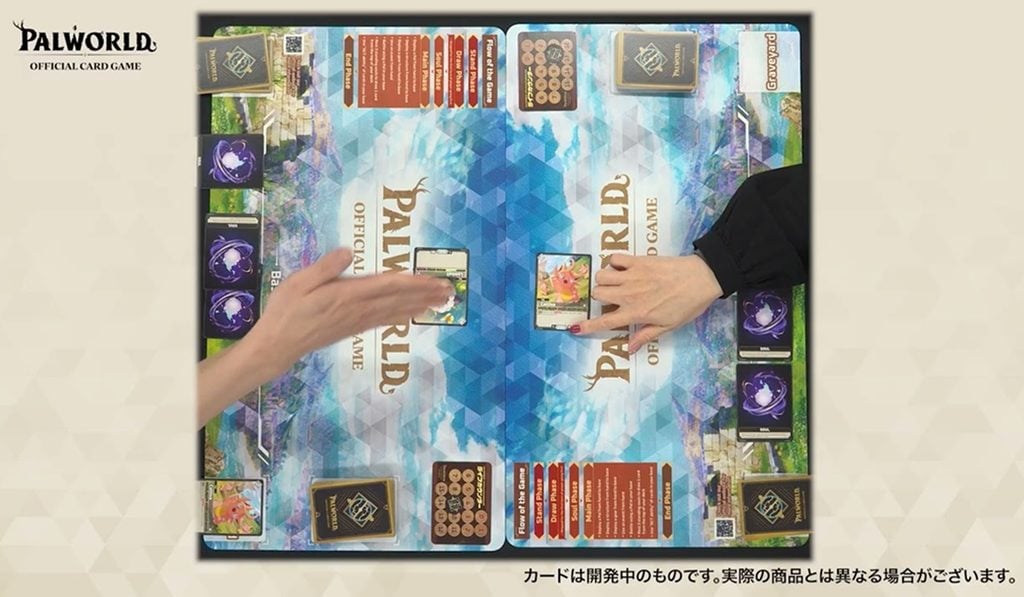
Palworld OCG is a fast, two-player tabletop duel. Two players build a base, deploy Pals, and either put them to work or send them to fight. Each player starts with 10 life and loses at 0 – or when their deck runs out. Here is the core loop.
- Two decks – The Main Deck holds exactly 50 cards, with at most four copies of a name and at most eight Lucky cards. A Soul Deck holds 10 cards.
- Five card types – Pals fight, and you can assign them to work at Structures. Gear equips Pals, Event cards are one-shot effects, and Souls are your resource rather than your life. They come in four colours – Red, Green, Blue and Purple – or colourless.
- Souls are the economy – Each Soul Phase, you move two Souls from the Soul Deck into play, up to ten. To play a card, you rest Souls equal to its cost. The player going second starts with one Soul in play.
- Turn structure – A turn runs through Stand, Draw, Soul, Main and End phases. The first player skips the Draw on turn one.
- Combat – A Pal can attack another Pal, a Structure or the player. Power decides the exchange against Pals and Structures. Against the player, only the attacker’s much smaller Strike counts.
- Damage checks – A player taking Strike damage moves cards from the top of their deck to the graveyard, one at a time. If a card with the Lucky icon turns up, it cancels the damage. Otherwise, the player loses that much life.
- Quick cards – You can play cards marked Quick during the opponent’s battle, so interrupts exist.
Sets, Printings and Parallels
Six weeks in, the catalogue is small but already layered. The table below shows what we identify as of September 2026.
The publisher has also announced Booster “Legends Awaken” (BP02, 30 October 2026), two “Eternal Ascent” trial decks (18 December 2026) and Booster “Eternal Ascent” (BP03, 29 January 2027).
| Product | Card prefix (EN / JP) | Released | Cards |
|---|---|---|---|
| Booster Pack “Dawn of Palpagos” | EBP01 / BP01 | 30 Jul 2026 | 100 base cards (34 C, 30 U, 24 R, 12 RR) + 61 parallels (30 SR, 15 OSR, 12 SP, 4 SSP) + 1 SSS Soul |
| Trial Deck “Dawn of Palpagos Red・Blue” | ETD01 / TD01 | 30 Jul 2026 | 24 deck cards (TD) + 12 TSR and 2 TSP foil variants + Soul |
| Trial Deck “Dawn of Palpagos Green・Purple” | ETD02 / TD02 | 30 Jul 2026 | 24 deck cards (TD) + 12 TSR and 2 TSP foil variants + Soul |
| PR Cards (2026) | EPR / PR | ongoing | EN: 9 promo Pals + 7 promo Souls. JP: 8 promo Pals, each also as an “S” foil variant, + 6 promo Souls |
The rarity ladder runs from Common (C) through Uncommon (U), Rare (R) and Double Rare (RR). Above those sit the parallels, which reuse the base number with the rarity appended. Super Rare (SR) keeps the base artwork with a foil finish. OSR, SP and SSP are full-art alternates of the top Rares and Double Rares.
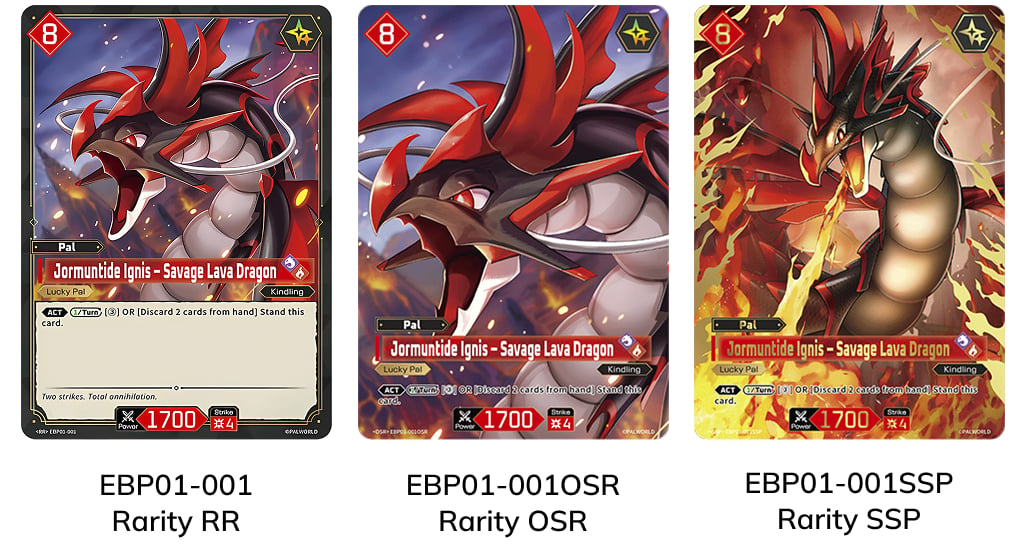
The strongest Pals exist in up to three treatments – Jormuntide Ignis is EBP01-001 (RR), EBP01-001OSR and EBP01-001SSP – and the suffix separates a common pull from a chase card.
What Comes Back for Every Palworld Scan or Photo
For each detected card, the API returns a standard set of identification fields. The example below is the alternate-art Jormuntide Ignis from the first booster.
| Field | Example | Description |
|---|---|---|
name | Jormuntide Ignis – Savage Lava Dragon | Printed name |
full_name | Jormuntide Ignis – Savage Lava Dragon Booster Pack “Dawn of Palpagos” EBP01-001OSR | Name, set and id in one string |
set | Booster Pack “Dawn of Palpagos” | Product name |
set_code | EBP01 | Prefix (E = English; JP is BP01) |
card_id | EBP01-001OSR | Printed number including the parallel suffix |
card_number | 001 | Number without prefix or suffix |
rarity | OSR | C, U, R, RR, SR, OSR, SP, SSP, SSS, TD, TSR, TSP, PR |
year | 2026 | Release year |
links | tcgplayer, ebay… | Marketplace links for pricing where available |
Japanese cards return the same structure, with the Japanese name and set and the un-prefixed code.
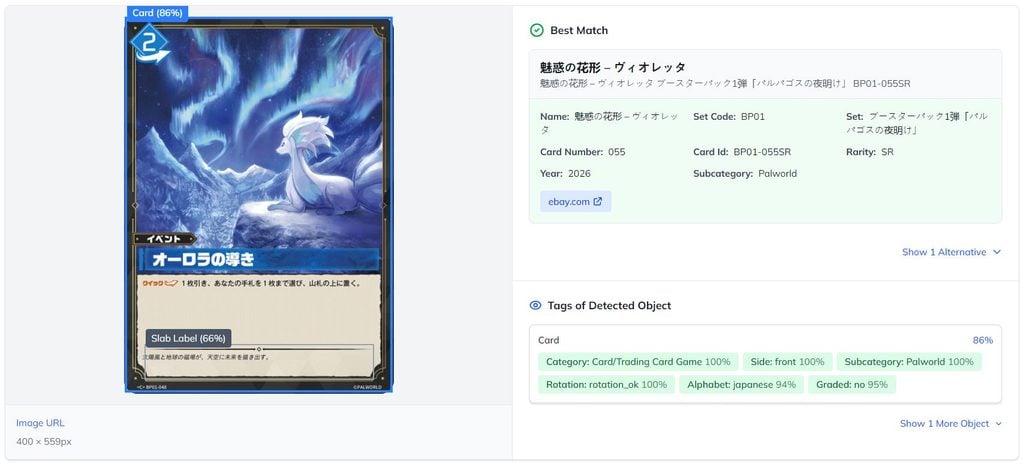
Test Palworld Card Recognition via the Ximilar App or API
The quickest way to try it is the TCG Identification test form in the Ximilar App. Sign up for free, upload a photo of any Palworld card, and you get back the exact card with the full record above. The form runs in your browser, with no download required. Our First Steps guide walks you through the setup.
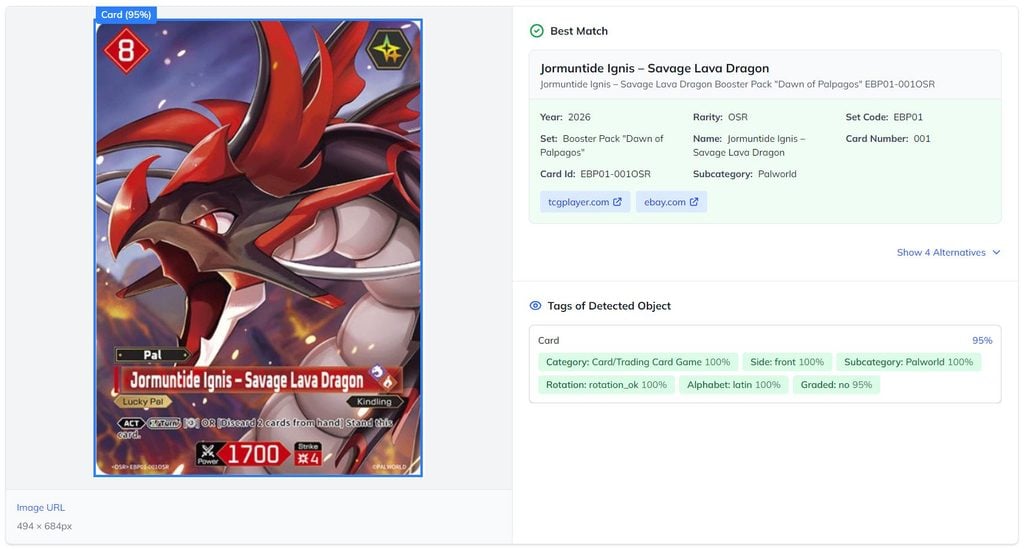
Everything the app does is also available through our REST API. Send a photo URL (or a base64 image) with your API token – no lang or game parameter needed:
curl --location 'https://api.ximilar.com/collectibles/v2/tcg_id' \
  --header 'Content-Type: application/json' \
  --header 'Authorization: Token YOUR_API_TOKEN' \
  --data '{"records": [{"_url": "https://your-server.com/photos/jormuntide-ignis.jpg"}]}'
A trimmed response looks like this:
{
  "records": [{
    "_objects": [{
      "name": "Card",
      "prob": 0.99,
      "_identification": {
        "best_match": {
          "name": "Jormuntide Ignis – Savage Lava Dragon",
          "set": "Booster Pack \"Dawn of Palpagos\"",
          "set_code": "EBP01",
          "card_id": "EBP01-001OSR",
          "card_number": "001",
          "rarity": "OSR",
          "year": 2026,
          "subcategory": "Palworld",
          "links": {"tcgplayer.com": "https://www.tcgplayer.com/product/..."}
        },
        "alternatives": [
          {"card_id": "EBP01-001", "rarity": "RR", "distance": 0.21},
          {"card_id": "EBP01-001SSP", "rarity": "SSP", "distance": 0.27}
        ]
      }
    }]
  }]
}
The alternatives list is worth watching. The nearest matches are often the other printings of the same number. So a collector app can offer “did you mean the RR or the SSP?” when the photo is too blurry to read the foil.
More Palworld Sets on the Way
We track every Bushiroad release as it lands. So Legends Awaken and Eternal Ascent will be identifiable shortly after they arrive, in both English and Japanese. The Simplified Chinese edition is not covered yet. If you need it, or any other game or language, let us know.
Building a collector app, a card marketplace or a scanning tool? Reach out to talk through your use case, try the demo, or sign up for free and scan your first Pal today.

Tags & Themes
Related Articles
Instance Segmentation on Click: Build Your Own AI Model
Train your own instance segmentation model with Ximilar’s no-code computer vision platform – from polygon annotation to a deployed API.
How to Train an Object Detection Model With One Click
Define, optimize and deploy to API your custom object detection model without coding.
Hololive Card Recognition for Card Scanners & Collector Apps
Ximilar’s AI now identifies every hololive OFFICIAL CARD GAME (hOCG) card – name, set, rarity, and more – in English and Japanese.