 Product Description
  Price Search
  Combine LLMs & Vision
  Fine-tune & Deploy
  Instance Segmentation
 Korean and Thai Pokémon Cards Now Supported in Our AI Recognition System
Ximilar’s card recognition AI now identifies Korean and Thai Pokémon trading cards, returning native-language card data alongside the standard identification fields. Let’s see it in action!

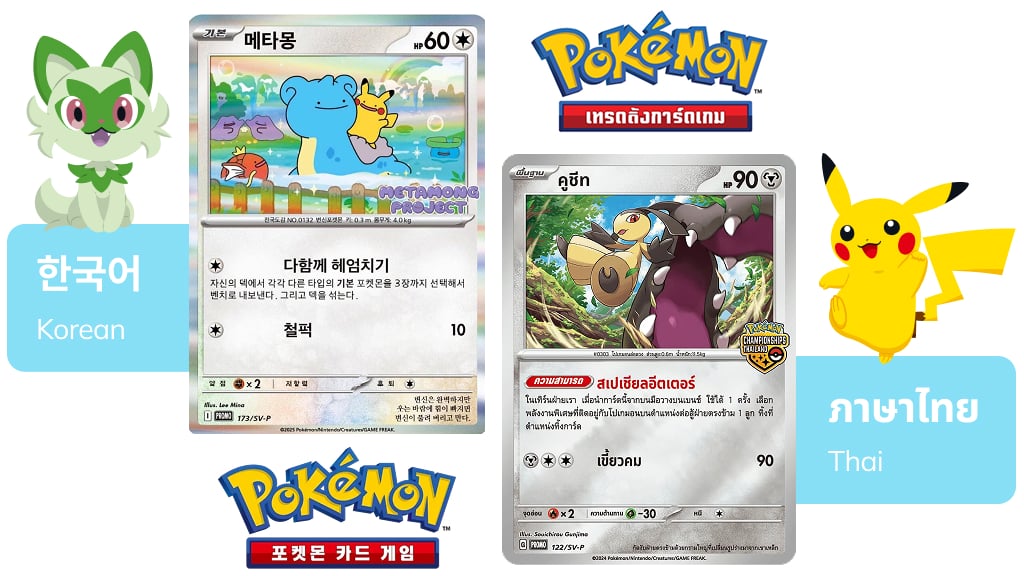
Our Collectibles Recognition system has been continuously expanding its Pokémon coverage beyond English and Japanese – we’ve previously added Simplified Chinese and Traditional Chinese support, and we’re now adding Korean and Thai.
Both languages come with full card identification, including native-script card names and set names returned directly in the API response. This update is available for testing via the Ximilar App and demo, and for integration through our REST API.
What is the AI Card Identifier?
Ximilar’s Collectibles Recognition service uses AI to analyze photos of collectible items and identify them one by one.
For trading cards, it detects the card in the image, then performs detailed identification – returning structured data such as card name, set, card number, rarity, and links to marketplaces. It can also extract information from graded slab labels and retrieve price statistics.
The service is used in collector apps, marketplaces, and scanning tools via a simple REST API.
What the TCG Identifier Returns for Each Card
For each recognized card, the system provides:
- Short and full card name, card number within the set (
name,full_name,card_number) - Set and set code, year of release (
set,set_code,year) - Language/alphabet – now including Korean and Thai (
alphabet) - Native-script card and set names (e.g.
ko_name,ko_setfor Korean;th_name,th_setfor Thai) - Foil/holo, side, and other card features (
foil_holo,side) - Pricing data and links to marketplaces (
links)
For a full overview of supported fields, see the Collectibles Taxonomy or the detailed API documentation.
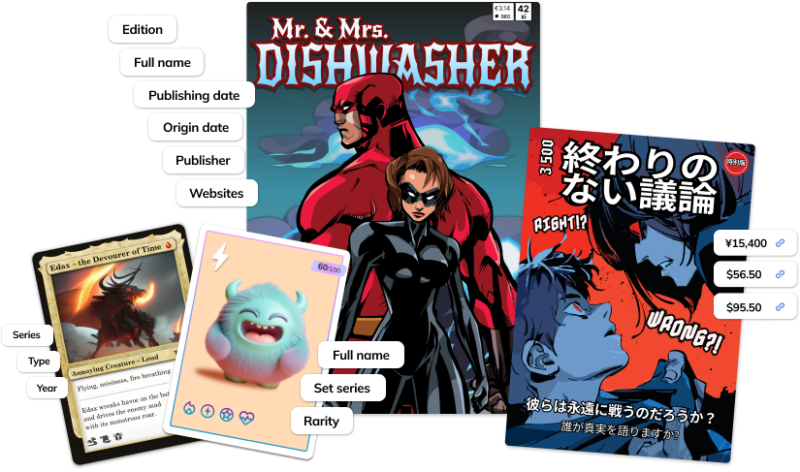
ONE API TO RULE THEM ALL
AI That Understands Collectibles
Recognize, analyze & grade collectibles, find them in databases and marketplaces. Our API was built by collectors for collectors.
Covered Games
Our recognition system now covers a wide range of trading card games:
- All-time classics, such as Pokémon, Yu-Gi-Oh!, and Magic: The Gathering
- Modern hits, including One Piece, Flesh and Blood, Digimon, and Dragon Ball Super
- Anime & crossovers like Weiss Schwarz, Union Arena, Vanguard, Gundam, and Final Fantasy
- Fantasy & indie favorites, e.g., Force of Will, Grand Archive, Sorcery: Contested Realm, and Riftbound
- Newer & special games, for instance, MetaZoo, Lorcana, Star Wars Unlimited, Marvel Champions, Garbage Pail Kids, and Star Wars Destiny
Pokémon alone is now recognized in six languages: English, Japanese, Simplified Chinese, Traditional Chinese, Korean, and Thai. Let’s put the two new language additions to the test.
Korean Pokémon Cards

Pokémon Card Collecting in Korea
South Korea has been one of the most enthusiastic Pokémon markets in Asia for decades. Japanese cultural imports were banned in Korea until October 1998 – once that ban was partially lifted, the franchise arrived quickly. The animated series premiered on Korean television in July 1999, and Wizards of the Coast released the Korean Base Set in 2000 under the title 포켓몬 트레이딩 카드 게임. Despite early enthusiasm, the TCG took time to establish itself – only two Korean sets were released before 2010 – but since the release of Start of an Adventure that year, Korean Pokémon cards (known as KTCG, or 포켓몬 카드 게임) have been a permanent and growing fixture.
Today, new Korean sets release on par with international ones. The South Korean competitive scene has also made its mark globally: in 2014, Park Se-jun became the first Korean winner of a Pokémon World Championship.
Korean Pokémon cards are increasingly sought after by international collectors. Part of the appeal is practical – Korean cards offer a lower cost of entry compared to their Japanese equivalents, with similar card stock quality and print finish. Their collectibility has also grown thanks to Korean promos and region-limited releases: some of the most talked-about Pokémon TCG products in 2025 were Korean-exclusives, including the Terastal Festival ex Playmat Set and a promotional Ditto (Metamong) card distributed at a series of events, which became one of the most sought-after Korean promos of the Scarlet & Violet era.
Korean Pokémon Card Recognition in Ximilar
Our system identifies Korean Pokémon cards via the /collectibles/v2/tcg_id endpoint. The alphabet is detected automatically – no extra parameter needed. It returns the following fields:
| Field | Description |
|---|---|
name |
Card name in English |
ko_name |
Card name in Korean (Hangul) |
full_name |
Full canonical card name |
set |
Set name in English |
ko_set |
Set name in Korean |
set_code |
Set code |
card_number |
Card number within the set |
year |
Year of release |
Test via Ximilar App
In this case, I tested by uploading an image of the Ditto SV-P #173 card into the TCG Identification test form in the Ximilar App. This 2025 Korean-exclusive promo from the Metamong Project event is one of the most popular Korean-exclusive cards of the Scarlet & Violet era.
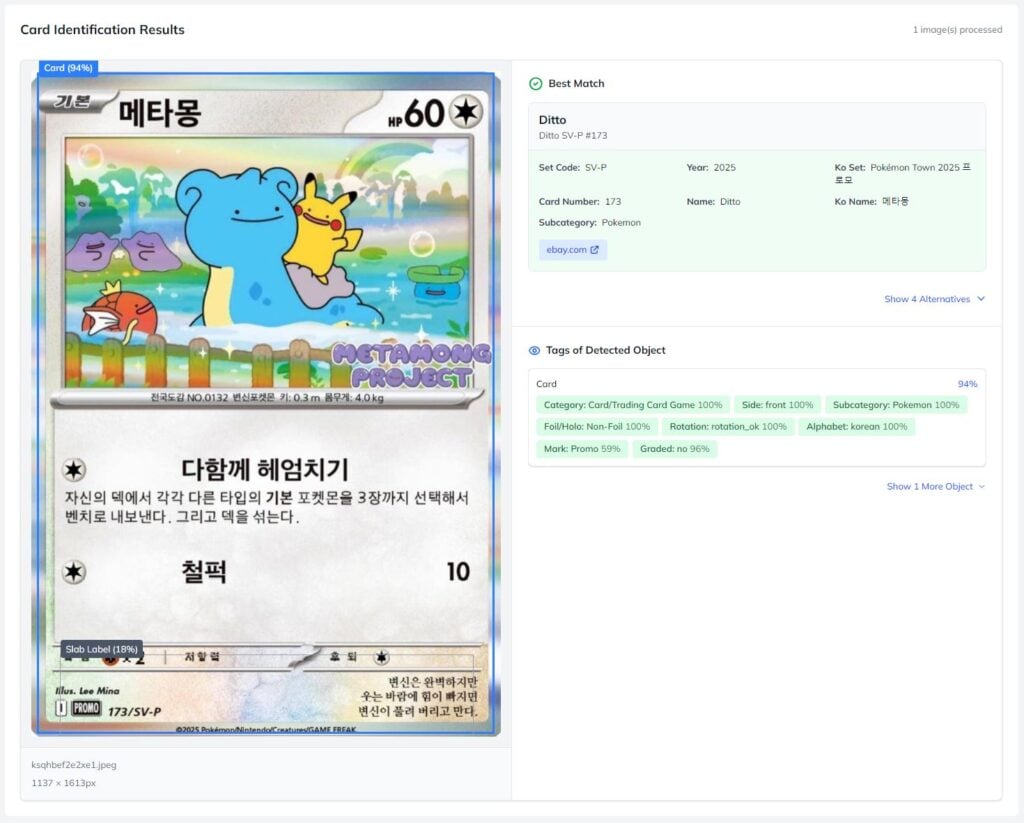
And here’s how you’d call the API. You can find both your cURL request and response directly under the test form. Don’t forget to replace YOURAPITOKEN with your personal token and keep it private, as it authorizes all requests made under your account.
curl --url "https://api.ximilar.com/collectibles/v2/tcg_id"
 --request POST
 --header "Accept: application/json, text/plain, */*"
 --header "Content-Type: application/json"
 --header "Authorization: Token YOURAPITOKEN" \
  --data-raw '{"records":[{"_base64":"/9j/IMAGECODE,filename":"ksqhbef2e2xe1.jpeg"}],"pricing":false}'
Here, I selected the part of the API response with the key card details:
{
  "name": "Ditto",
  "ko_name": "메타몽",
  "full_name": "Ditto SV-P #173",
  "set": "Pokémon Town 2025",
  "ko_set": "Pokémon Town 2025 프로모",
  "set_code": "SV-P",
  "card_number": "173",
  "year": 2025
}
Thai Pokémon Cards
Pokémon Card Collecting in Thailand – a Fast-Growing Market
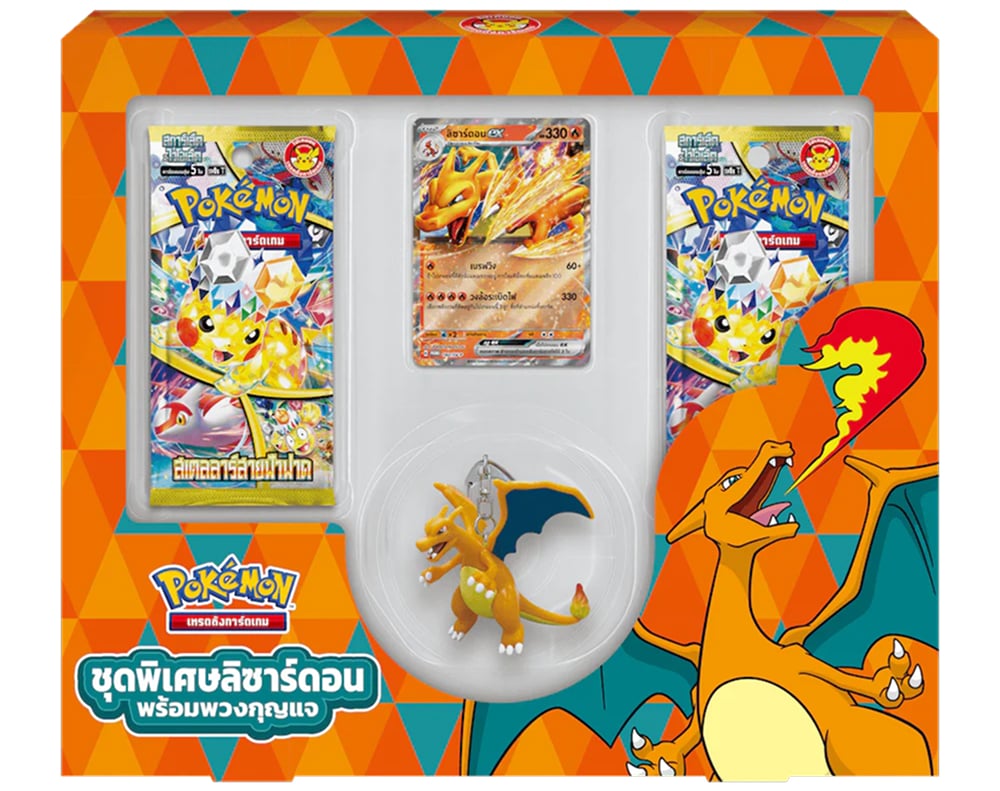
The Pokémon franchise arrived in Thailand around 2000, and Thai-language cards (โปเกมอนการ์ด) have been officially distributed since the mid-2000s. Thai cards feature full Thai-script translations of card names, set names, and game text, and follow the same rarity structure and booster box format as other regional releases – but with a distinct regional identity that has earned them a loyal collector base.
What makes the Thai market particularly interesting is the existence of truly Thai-exclusive releases: sets and promos never printed in English or Japanese. A good example is Bonds of Destiny (April 2025), a Scarlet & Violet era expansion released exclusively in Thailand and Indonesia, featuring Special Illustration Rare and Hyper Rare cards unavailable in any other print run. Thai championship promos – such as the Mawile 122/SV-P tournament prize card – are among the rarest Pokémon cards by print volume, making authentication and correct identification genuinely important for collectors and card market listings alike.
The biggest recent signal of Thailand’s growing status: Pokémon Center BANGKOK is set to open at CentralWorld later in 2026, becoming the third permanent Pokémon Center outside Japan and reportedly its largest. The Pokémon Company’s investment here reflects just how seriously Thailand is now taken as a Pokémon market.
Thai Pokémon Card Recognition in Ximilar
Our system identifies Thai Pokémon cards and, like Korean, detects the language automatically.
One field unique to the Thai dataset is out_of, which returns the total number of cards in the set or print run where available – useful context for understanding a card’s rarity and collectibility within its series.
| Field | Description |
|---|---|
name |
Card name in English |
th_name |
Card name in Thai script |
full_name |
Full canonical card name |
set |
Set name in English |
th_set |
Set name in Thai |
set_code |
Set code |
series |
Series name |
card_number |
Card number within the set |
year |
Year of release |
out_of |
Total cards in the set/print run (where available) |
Test via Ximilar App
In this case, I uploaded an image of a unique Mawile SV-P #122 (คูชีท) Scarlet & Violet Black Star Promo card from 2023 via URL into the test form, and the system returned both the English and Thai card and set names, series, and card number.
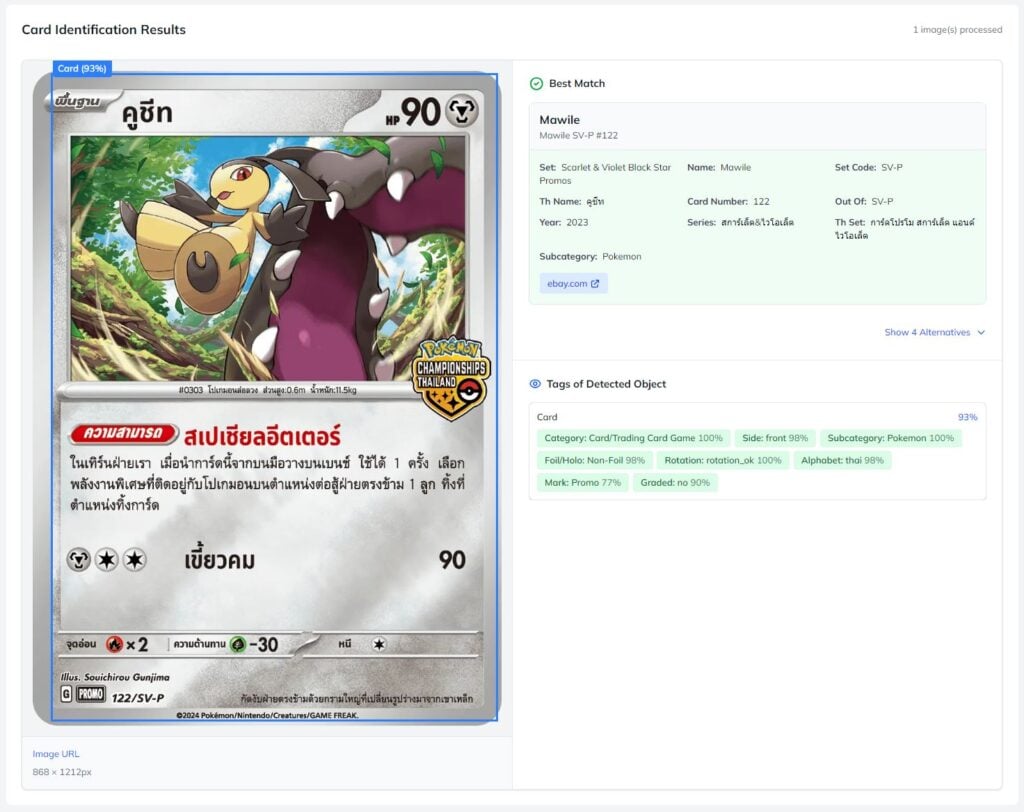
This is the structure of the API request. You can find it directly under the test form in the Ximilar App. Don’t forget to replace YOURAPITOKEN with your personal token and keep it private, as it authorizes all requests made under your account.
curl --location 'https://api.ximilar.com/collectibles/v2/tcg_id' \
--header 'Authorization: Token YOURAPITOKEN' \
--header 'Content-Type: application/json' \
--data '{
    "records": [
        {
            "_url": "https://cdn6966.templcdn.com/wp-content/uploads/2026/03/TH_122SV-P.png"
        }
    ]
}'
And once again, here’s the selected part of the response with the key information:
{
  "name": "Mawile",
  "th_name": "คูชีท",
  "full_name": "Mawile SV-P #122",
  "set": "Scarlet & Violet Black Star Promos",
  "th_set": "การ์ดโปรโม สการ์เล็ต แอนด์ ไวโอเล็ต",
  "set_code": "SV-P",
  "series": "สการ์เล็ต&ไวโอเล็ต",
  "card_number": "122",
  "out_of": "SV-P",
  "year": "2023"
}
How to Test via API
You can test both Korean and Thai card identification using the /collectibles/v2/tcg_id endpoint. Whenever you run a card through the Ximilar App, the corresponding cURL command and full API response appear directly below the results table.
A full quickstart guide is available in the API documentation, and you can get your authentication token after signing up:
More Languages on the Way
With Korean and Thai now covered, Ximilar’s Pokémon card identifier supports English, Japanese, Simplified Chinese, Traditional Chinese, Korean, and Thai – making it one of the most comprehensive multilingual Pokémon card recognition systems available via API.
We’re continuing to expand language support and improve accuracy across all existing games. If you’re missing a language or a TCG you’d like us to support, let us know. If you’re building a collector app, card market, or scanning tool and want to discuss your use case, reach out – we’re happy to help.

Zuzana Raidová
Head of Marketing
Zuzana is a marketing specialist, biologist, and illustrator addicted to reading and hiking. At Ximilar, she takes care of web content and communication, tries to keep the articles engaging, and the office temperature low. She likes science, kung fu movies, and rain.
Tags & Themes
Related Articles

Wake Up, Collector: Cyberpunk TCG Card Recognition Is Here
Ximilar’s card AI now recognises Cyberpunk TCG cards – name, set, and rarity from a single scan. Test it in the App, via API or the demo.
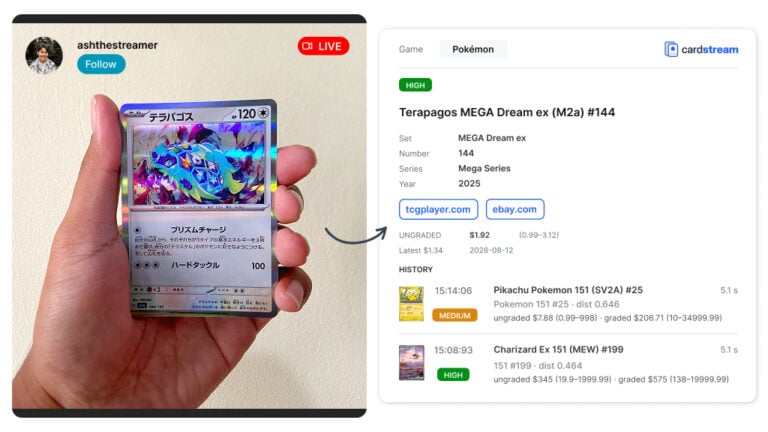
Cardstream.ai: Open-Source Card Scanner for Live Streams
An open-source card scanner for live streams. Cardstream identifies TCGs like Pokémon and sports cards in real time from your video.
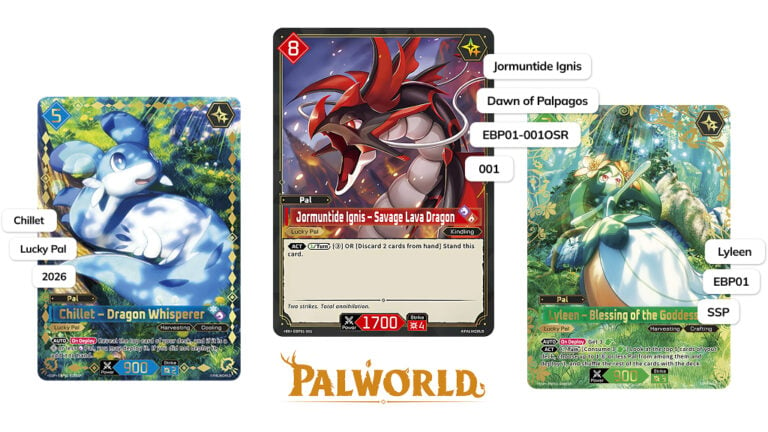
Recognize Every Palworld TCG Card in English and Japanese
Ximilar’s card AI now handles Palworld card recognition in English and Japanese, from a single scan. Test it in the App, via API or the demo.